Your Best Choice for Implant Restoration
In the Maple Leaf, Northgate, Green Lake & North Seattle Area
Is an Implant Restoration right for me?
Can implants be restored?
Yes! If your implant restoration, whether it’s a crown, bridge or denture, has become damaged and is in need of repair, don’t delay visiting the dentist. Many believe that a damaged restoration means that the entire implant (post and all) will need to be replaced and a new one put in, but that is rarely the case. An implant restoration usually fixes the problem without any affect on the implant post.
Damaged and missing teeth can bring disruption and discomfort to daily life. You chose a dental implant because of the long-lasting and natural-looking solution it provided for your missing tooth or teeth. While the implant screw itself can last a lifetime, the tooth-like crown placed on top of your implant may eventually need to be replaced. Implant crowns typically last 10-15 years before wear and tear become noticeable and a new restoration is necessary.
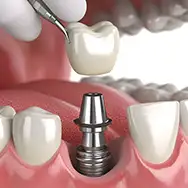
At Maple Leaf Smiles, we can restore your dental implant so you can get your life back to normal!
Important questions to consider before getting a new implant restoration.
• Solution — Can implants be restored?
• Education — What is an implant restoration?
• What to Expect — How does the implant restoration process work?
• Preparation - How do I prepare?
• Materials — What restorative options do I have?
• Affordability — How much will it cost?
• Results — How long will it last?
• Recovery — What will recovery be like?
What is an Implant Restoration?
A dental implant restoration is the placement of an artificial tooth on top of a dental implant. The word “restoration” is referring specifically to the fake tooth (most commonly a crown) that sits on top of the implant post (the part attached to the jaw). Crowns, bridges and other restorations are durable and long-lasting; however, over time they can chip or break due to normal wear and tear. When restorations are replaced, the implant post itself remains untouched.
How does the implant restoration process work?
An implant restoration is typically needed once a tooth has become so worn that it is no longer biting properly and is therefore causing tooth and jaw pain. When this happens, the old restoration is removed from the implant and a new one put in its place. The entire process can be completed in one visit and usually takes less than an hour.

Benefits of implant restorations from Maple Leaf Smiles
HOW DO I PREPARE?
Our Consultation or Second Opinion Includes:
One-on-One Doctor-Patient Education — We will explain all the details of your oral health and the entire treatment process. We will answer any questions you might have.
Customized Treatment Planning — Your treatment will be designed around your specific needs, timeline and budget. We will also review pricing and financial options, if needed.
Intraoral Exam — A thorough exam of your mouth will be performed prior to treatment. This will allow us to properly assess your oral condition.
MATERIALS — What restorative options do I have?
There are different types of dental restorations and materials for patients to choose from
when replacing missing teeth. The most common restoration for a single tooth replacement is a dental crown, which can easily be affixed on top of a dental implant. A bridge and denture are a more popular choices for replacing multiple teeth and require multiple implants for support. Crowns, bridges and dentures can be created from porcelain or zirconia. These materials are durable and long-lasting and can be colored to match the look of the natural teeth. We will work together to determine the best restorative option and material for you.
AFFORDABILITY — How much will it cost?
The price of the restoration is determined by the restoration type and material. We will go over all pricing and financial expectations prior to the procedure. We don’t want the cost of a restoration to keep you from receiving the treatment you need. Our team at Maple Leaf Smiles offers various financing options to make dental care more affordable for our patients.
DURABILITY — How long will it last?
Dental implants (the post attached to the jaw) can last a lifetime when cared for properly. Implant restorations which sit on top of a dental implant typically last 10-15 years before wear and tear require replacement. Daily brushing and flossing, eating healthy foods, and maintaining routine dental visits all contribute to the longevity of a dental restoration and can extend the life of a crown beyond 15 years. The location of the dental implant can also play a role in how long the restoration will last. Implant restorations in the back of the mouth used for chewing food often tend to wear out faster than those closer to the front of the mouth.
SERVICE & CARE — What will recovery be like?
As with any treatment provided at our office, we will look after you from start to finish. Luckily, an implant restoration is not painful. The restoration that is removed and then replaced has no connection to any nerves in the jaw and therefore makes for a quick recovery. We expect you to be back to your normal routine as soon as the day following your procedure.
What does dental implant treatment and recovery involve?
Dental implants are an excellent replacement option for missing teeth. They can be placed at the same time as a tooth extraction or after the jaw has healed following an extraction. Your dentist will decide which time is best for your specific circumstance to achieve the best outcome. The general timeline and steps of dental implant treatment are as follows:
• Implant Placement: Beginning of treatment
• Suture Removal: 4 weeks after Implant Placement
• Implant Integration Verification and Impression: 4-5 months after Implant Placement
• Final Crown Placement: 3 weeks after Impression
• Total Treatment Time: 5-6 months*
*If a tooth needs to be extracted first and the dental implant cannot be placed at the same time, an additional 3-4 months may be required. Also, certain underlying health concerns may slow healing times, resulting in a longer than normal treatment timeline.
Dental implants recovery
Placing a dental implant is a form of surgery, and with any surgery it is typical to experience various forms of discomfort including swelling, bruising, pain and minor bleeding. We have post-procedure tips to share to ensure your recovery goes as smoothly as possible, and if appropriate, we can prescribe medication to lessen any pain.

What are dental implants?
Dental implants are an increasingly popular method for replacing missing teeth. In this procedure, titanium supports are surgically fused with your jawbone, and act as an anchor for natural-looking false teeth. Dental implants are not only used for individual tooth replacement, but can also be used when replacing multiple teeth as an alternative or adjunct to dentures.
What are Advantages of Dental Implants?
• Implants are extremely natural looking • Fusion of the implants into your jaw makes them very stable and natural feeling • Chewing function is restored to near-natural levels • No need to remove tooth structure from adjacent teeth • They have a very good long-term prognosis
Disadvantages of Dental Implants
Not everyone is a candidate for dental implants. The process of getting implants can be time consuming and requires multiple visits to the dentist. There is a chance that surgery fails (roughly 5% of the time).